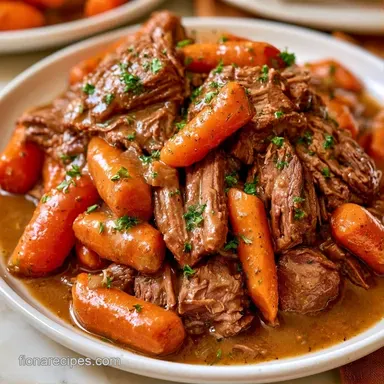
Slow-Cooked Beef Pot Roast with Baby Carrots

- Time: 15 min active + 3 h cooking
- Flavor & Texture: Savory, rich, and fork-tender
- Perfect for: Sunday family dinner
Beef Pot Roast with Baby Carrots
The sound of the beef hitting a hot Dutch oven and that instant sizzle is where it all begins. That deep golden brown crust creates the depth of flavor you can't get from just simmering.
You don't need to submerge the meat in liquid to get it tender, because the steam in the covered pot does the heavy lifting. This version of beef pot roast with baby carrots hits the sweet spot of richness without feeling greasy.
It's real food for a slow afternoon. You get a meal that feels fancy but mostly just requires a bit of patience and a heavy lid.
Why the Slow Heat Works
- The Hard Sear: Browning the meat at high heat creates a crust that adds a deep, savory base to the gravy.
- Collagen Melt: Low heat over several hours turns tough connective tissue into silky gelatin.
| Method | Time | Texture | Best For |
|---|---|---|---|
| Oven Braise | 3 hours | Tight but tender | Deep flavor, rich gravy |
| Slow Cooker | 8 hours | Very soft | Hands-off cooking |
Gathering Your Essentials
The choice of meat is crucial for this recipe. A chuck roast provides the necessary fat and connective tissue to stay moist throughout three hours of cooking. Combining beef broth with a touch of vinegar introduces a bright, zesty element that cuts through the heavy flavors.
Opting for baby carrots is a wise move. They maintain their form far better than sliced carrots, ensuring you don't end up with orange mush in your pot.
The Ingredient List
- 3 lbs beef chuck roast Why this? Abundant collagen keeps it tender
- 2 tbsp vegetable oil Why this? Withstands high heat without burning
- 1 tsp kosher salt
- 1 tsp cracked black pepper
- 1 large yellow onion, quartered
- 2 cups beef broth Why this? Forms a rich, flavorful braising liquid
- 1 tbsp vinegar Why this? Provides a tangy contrast to the richness
- 3 cloves garlic, smashed
- 2 sprigs fresh thyme
- 1 sprig fresh rosemary
- 1 lb baby carrots, whole Why this? Maintains shape during the slow braise
- 1½ lbs Yukon Gold potatoes, cut into 2-inch chunks Why this? Offers a buttery consistency that stays intact
| Original Ingredient | Substitute | Why It Works |
|---|---|---|
| Yukon Gold Potatoes | Red Potatoes | Comparable waxy feel. Note: A bit firmer |
| Fresh Thyme/Rosemary | Dried Herbs (1 tsp) | Similar taste profile. Note: Lacks the punch of fresh herbs |
| Beef Broth | Low-Sodium Beef Stock | Virtually the same. Note: Better for managing salt |
Tools for the Job
You need a 5.5-quart Dutch oven. A heavy bottom is a must because it distributes heat evenly and prevents the beef from scorching during the sear.
A wooden spoon helps you scrape the bottom of the pot to get every bit of flavor. A meat thermometer is the most reliable way to know when the beef is ready to shred.
Bringing It Together
Phase 1: The Flavor Foundation
- Set your oven to 300°F (150°C).
- Generously season all sides of the 3 lbs beef chuck roast with 1 tsp kosher salt and 1 tsp cracked black pepper.
- In a 5.5-quart Dutch oven, heat 2 tbsp vegetable oil over medium-high heat until shimmering.
- Sear the beef for 5–7 minutes per side until a deep golden brown crust forms, then transfer the meat to a plate.

- Add the quartered yellow onion and sauté for 3 minutes until the edges are charred.
- Pour in 2 cups beef broth and 1 tbsp vinegar, scraping the bottom of the pot with a wooden spoon to loosen the browned bits.
- Stir in the 3 cloves smashed garlic, 2 sprigs fresh thyme, and 1 sprig fresh rosemary.
Phase 2: The Slow Braise
- Return the roast to the pot, ensuring the liquid reaches roughly one-third of the way up the sides. Note: Avoid covering the meat completely to ensure it braises rather than boils.
- Cover the pot and bake at 300°F (150°C) for 2 hours.
Phase 3: The Vegetable Finish
- Carefully arrange 1 lb baby carrots and 1½ lbs potato chunks around the beef, making sure they are partially submerged in the liquid.

- Continue cooking until the roast hits an internal temperature of 200°F (93°C) and pulls apart easily with a fork.
Phase 4: The Final Reduction
- Move the meat and vegetables to a serving platter and tent with foil to rest.
- Simmer the remaining juices on the stove over medium-high heat for 5–10 minutes until the liquid thickens into a glossy gravy.

Quick Fixes
If the meat feels rubbery, it's not a fail. It just means the collagen hasn't fully melted into gelatin yet. Give it more time in the oven.
When the vegetables look too soft, it's usually because they went in too early. Staggering the entry keeps the carrots intact.
Handling Tough Meat
The beef needs to reach 200°F to shred. If it resists, put it back in the pot for 30–60 minutes.
Preventing Mushy Carrots
Adding carrots in the last hour prevents them from dissolving into the sauce.
Fixing Thin Gravy
Simmer the liquid on the stove after removing the meat. This reduces the water and concentrates the flavor.
| Problem | Fix |
|---|---|
| Meat is tough/chewy | Return to oven for 30–60 minutes |
| Carrots are too soft | Add vegetables later in the process |
| Gravy is too watery | Simmer on stovetop for 10 minutes |
Make It Your Own

I like adding a pinch of brown sugar to the broth if the carrots aren't sweet enough. You can also swap the thyme for a bay leaf for a more classic, earthy taste.
If you have extra carrots or onions from your prep, they're great for a hidden veggie sauce later in the week.
| Addition | Effect | Best For |
|---|---|---|
| Pearl Onions | Sweeter, whole bites | Sunday dinner |
| Celery Chunks | More traditional base | Hearty stews |
| Balsamic Vinegar | Deeper, tangier glaze | Richer flavor |
Keeping It Fresh
Keep any remaining portions in a sealed container in the refrigerator. Per USDA guidelines on leftovers, these are safe for 3 to 4 days.
This meal is freezer-friendly. Combine the meat and carrots with the gravy and freeze for as long as 3 months. To defrost, let it sit in the refrigerator overnight. Warm the meat in a lid-covered pot on low or in the oven at 300°F until the internal temperature hits 165°F (74°C).
Don't let the braising liquid go to waste; keep it to use as a foundation for beef stew or as a savory gravy for mashed potatoes.
Perfect Complements
While this roast is a hearty main, pairing it with some steamed green beans or a fresh garden salad helps offset the richness. Don't forget a slice of crusty sourdough bread to soak up every last drop of gravy.
Questions Readers Ask
What is the best cut of beef to use in a pot roast?
Beef chuck roast is the ideal choice because its high collagen content breaks down into gelatin during the slow cook.
Tip: look for a piece with plenty of white fat marbling to ensure the meat stays juicy.
How long does it take carrots to soften in a crock pot?
They generally require several hours of simmering to reach a tender consistency in a slow cooker.
Tip: place the carrots at the bottom of the pot where the heat is most intense.
Can I use baby carrots in a pot roast?
Yes, baby carrots are excellent for this dish because they maintain their shape better than sliced carrots.
Tip: nestle them around the roast during the final hour of cooking to avoid overcooking.
Which label is used for pot roast in the grocery store?
Look for packages labeled as chuck roast or beef roast.
Tip: avoid lean cuts like sirloin, as they will become tough and dry during a long braise.
How do I scale the cooking for a smaller roast, around 2 lb?
Reduce the beef broth and vinegar proportionally and begin checking the internal temperature earlier than the standard time.
Tip: use a smaller Dutch oven to ensure the liquid still reaches one-third of the way up the meat.
Is it possible to make this in a slow cooker, and does it need added water?
Yes, it takes about 8 hours in a slow cooker using the beef broth as the primary liquid.
Tip: sear the beef in a pan first to develop the deep golden brown crust that adds depth to the gravy.
Should I cut the roast into pieces or leave it whole?
Leave the roast whole to preserve its internal moisture and ensure a fork-tender result.
Tip: slice the meat against the grain after it has rested for the most tender bite.
Why is there too much gravy in the slow cooker, and what should I do with it?
Slow cookers trap steam and prevent liquid evaporation, which results in a thinner sauce.
Tip: transfer the liquid to a saucepan and simmer over medium-high heat for 5–10 minutes until it thickens.
Tender Beef Pot Roast with Baby Carrots